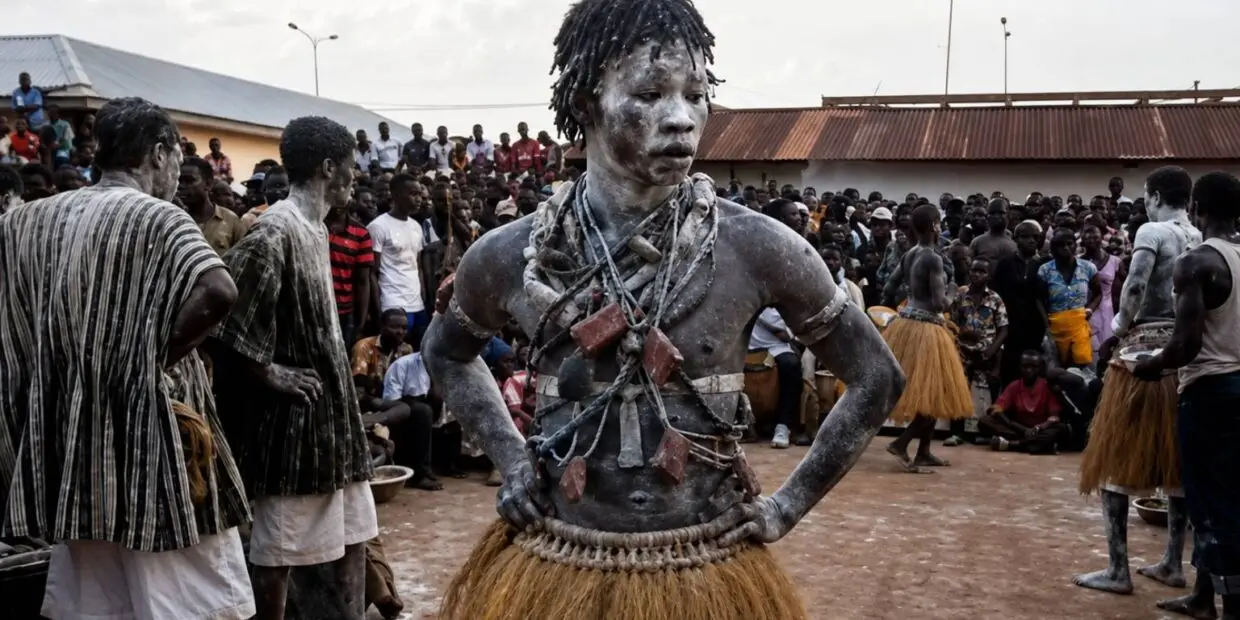
A proposal to establish Apoo as the year-transition festival of the Akan calendar, positioned between the final month, ƆDEFOƆ, and the first month, ƆPEPƆN, of the new Akan year. Apoo is more than a festival. For the Bono people, it is associated with the Bono people and particularly with Techiman; it represents a period of reflection, purification, accountability and reconciliation—a time to confront wrongs, settle grievances and reject what should not be carried into the next cycle. The festival’s name derives from the Bono verb po, “to reject”. The rejection is directed toward social ills such as corruption, wrongdoing, disease and other conditions considered harmful to the community.
That meaning makes Apoo naturally suited to the transition between one Akan year and the next.
The proposal for the NKRON-MA Akan calendar is therefore simple:
Abundance → Reconciliation → Renewal
The final month, ƆDEFOƆ, represents the completion of the year’s productive journey. Ɔdefoɔ refers to a person’s prosperity, achievement, self-reliance, dignity, and ability to contribute to family and community. But reaching ƆDEFOƆ should not mean simply having accumulated wealth. A person may finish a successful year while still carrying disagreements, resentment, wrongdoing or broken relationships.
This is where Apoo becomes essential.
ƆDEFOƆ asks, “What have we achieved?”
APOƆ asks, “What must we correct and leave behind?”
THE NEW YEAR asks, “What will we build next?”
Apoo therefore becomes the bridge between the completed year and the new year.
A fixed period makes the calendar useful.
If the Akan calendar is going to be used in everyday Akan community life, its important occasions need to be predictable. This is especially important for Akan gathering spaces, including worship buildings, community centres, cultural centres, schools and other places where Akan people meet.
A building using the Akan calendar should be able to announce:
“Apoo begins on this Akan date every year.”
People can then organise their lives around it.
Families can plan gatherings. Communities can organise reconciliation programmes. Worship spaces can dedicate services to reflection and renewal. Cultural centres can prepare exhibitions and performances. Akan organisations can coordinate activities across different locations. The Gregorian calendar can still be used for modern administration and international travel. It simply becomes the conversion date.
The Akan calendar determines the cultural occasion.
The Gregorian calendar provides the corresponding civil date.
Why certainty matters
A festival whose date is uncertain is difficult to build into people’s lives.
When people know the period of years ahead, they can:
- plan annual leave;
- arrange family gatherings;
- organise community programmes;
- prepare worship and cultural activities;
- book travel and accommodation;
- invite visitors;
- organise tourism;
- coordinate Akan communities in Ghana and abroad.
The benefit is not only tourism.
It is participation. A predictable calendar helps people remember, anticipate and return. It gives the occasion a permanent place in the annual rhythm of life.
Cancellation should not change the calendar.
Extraordinary circumstances may sometimes prevent a public celebration. That does not mean the traditional date itself needs to become uncertain.
The principle is simple:
The calendar date remains; the public programme can change when necessary.
This allows flexibility without losing predictability.
Apoo can therefore remain adaptable while still being something people can plan for years ahead.
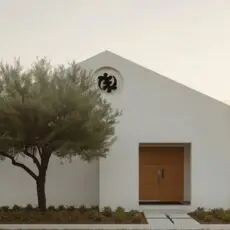
The Akan gathering space
This becomes particularly important when an Akan calendar is actively used inside a gathering space. Imagine an Akan worship or community building where the annual calendar is displayed.
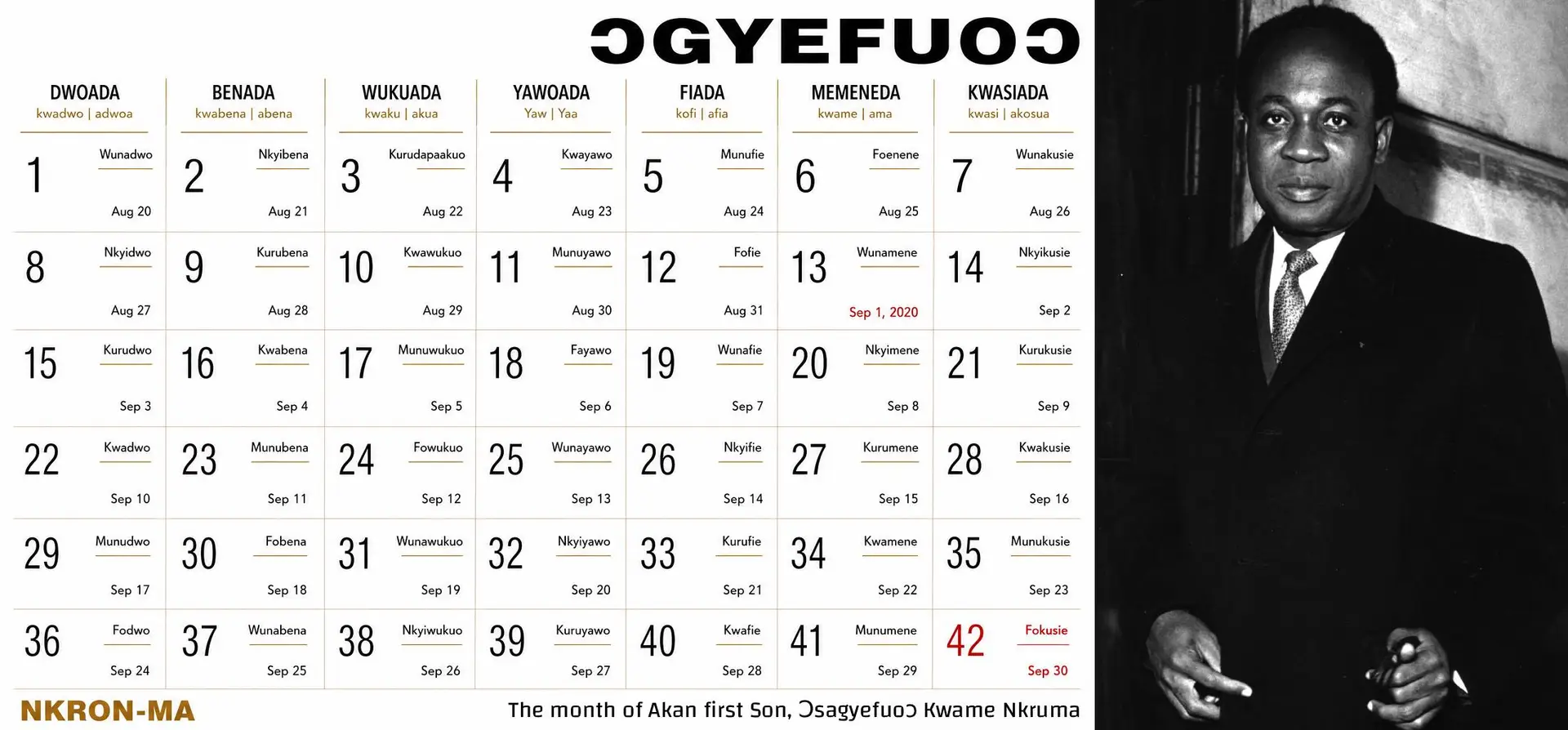
The final month is marked:
ƆDEFOƆ — Completion and Abundance
The following period is marked:
APOO — Reconciliation and Purification
Then:
NEW YEAR — Renewal and New Beginning
The building itself becomes a place where people experience the calendar rather than merely read it. A worship service, community meeting, cultural programme or family gathering can therefore follow the same annual rhythm:
complete → reconcile → renew → begin.
This gives the Akan calendar a practical purpose. It becomes something people live with, not simply something displayed on a wall.
The New Akan Year
The proposed NKRON-MA New Year would therefore not begin on 1 January.
It would begin according to the Akan calendar, at the transition following ƆDEFOƆ and Apoo.
The final week of ƆDEFOƆ provides a period of completion and reflection.
Apoo provides the period of reconciliation and purification.
The first part of the new year provides the opportunity for renewal and beginning again.
The New Year is therefore not simply a change of date.
It is a change of condition.
People enter it having had time to consider the previous year, resolve what can be resolved, and leave behind what should not continue.
A simple principle for the Akan calendar
The purpose of fixing Apoo within the Akan calendar is therefore not to make the festival rigid.
It is to make the Akan calendar dependable.
People should know the occasion before the year begins.
Akan gathering spaces should be able to programme it.
Families should be able to plan around it.
Communities should be able to prepare for it.
Visitors should be able to arrange their journeys.
And future generations should know that this period belongs permanently to the Akan annual cycle.
The principle is simple:
ƆDEFOƆ — we complete what we have built.
APOO — we reconcile what has been broken.
NEW YEAR — we begin again.
This makes Apoo more than an annual celebration.
It makes it the threshold of the Akan New Year.
And it gives the Akan calendar a living rhythm.