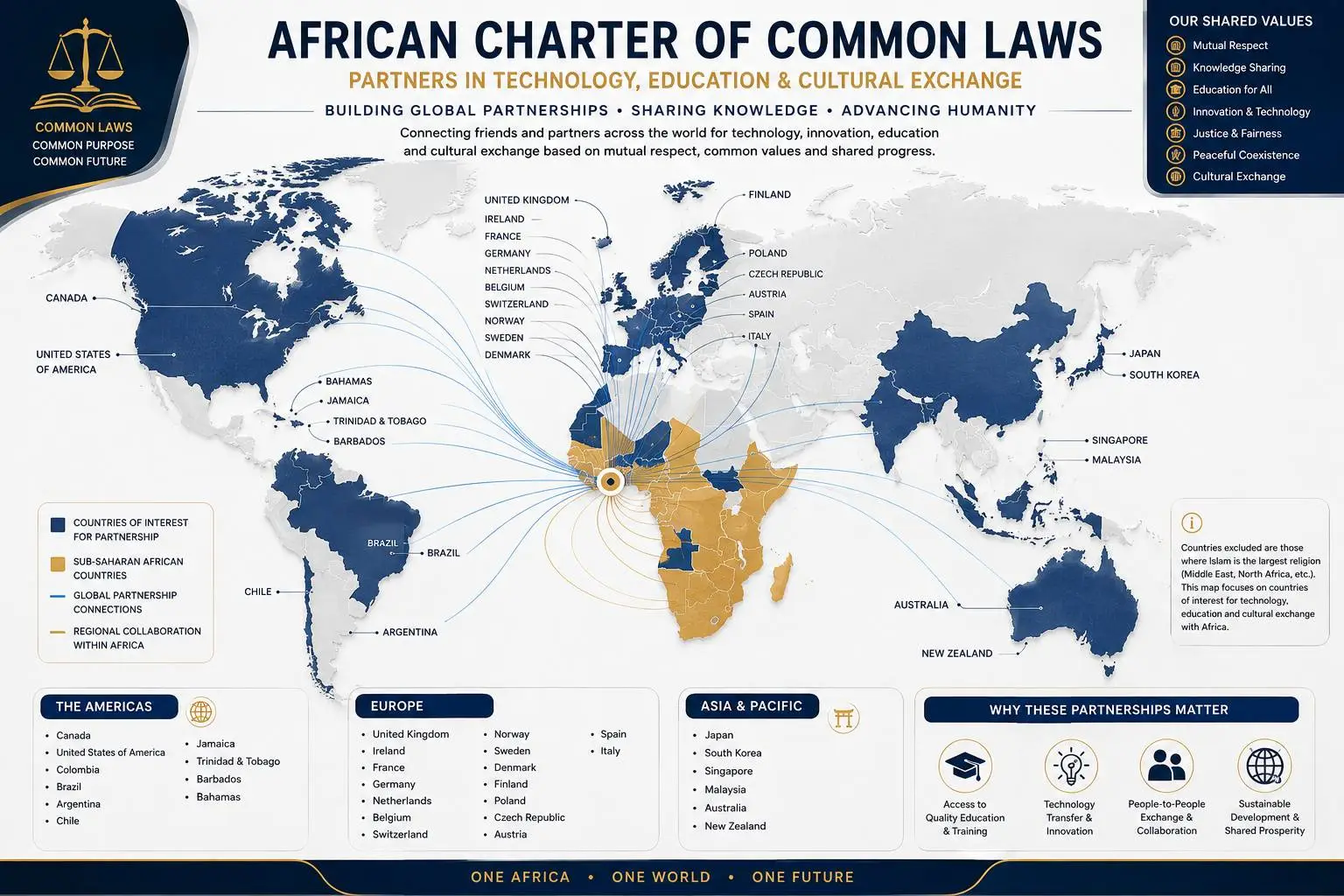
The AFRICAN CHARTER OF COMMON LAWS for Friendship, Community Partnership, and Culture.
Also known as the Akan Charter of Common Laws, are requirement set of laws that guide friendship by MUTUAL RESPECT and NOT by your Religion, Tribe, Wealth, Political Interest, or Proximity affiliation.
For many years, Africans have spoken of Pan-Africanism and the need for African unity. Yet we must also be willing to confront an uncomfortable reality: sharing a continent, a history or even the same skin colour does not automatically make people friends. Africans remain divided, especially on religion, culture and competing interests. In some cases, an African can be taught to regard another African as an enemy and deserve to be killed simply because that person follows a different religion.
For many decades and centuries past, Africans were and are still brought together simply by circumstance. Akans, Guan, Ga-Dangme, Ewe, Mole-Dagbani and others have travelled and settled among other African communities. Living close to one another can create cooperation, but it can also create fears and grievances. An Akan or other communities living among Akan people may wonder whether their culture, ancestral traditions and identity will be respected.
You do not have to become me for us to become friends.
The Charter therefore does not argue that one people is naturally better than another, nor does it seek to create hostility toward Christianity, Islam or any other religion. Instead, it questions the idea that Africans must abandon their ancestral identity, culture, or traditions to belong to a wider community. A person’s faith should not automatically make another African their enemy, just as a person’s ethnicity should not determine whether they deserve friendship.
This is why the Charter places conduct above identity. It asks not simply “What tribe are you?” or “What religion do you follow?” but “How do you treat other people?”
Do you respect human dignity? Do you protect children and vulnerable people? Do you respect women and men, elders and young people? Do you allow other communities to preserve their traditions? Can you live peacefully with someone whose beliefs are different from yours?
These are the foundations upon which genuine friendship can be built.
The Charter is therefore an invitation to seek new friends and allies beyond the limits of immediate geography. The principle is reciprocal: the protection we demand for ourselves must also be available to others. If we want freedom from religious or cultural persecution, we must not become persecutors. If we want friendship, we must be prepared to become friends.
The 100 Laws that follow are an attempt to establish that common ground — a framework for mutual respect, human dignity, cultural preservation, peaceful coexistence, community responsibility and accountability.
They do not require us to become one people.
That is the purpose of the African Charter of Common Laws.
Human Dignity & Cultural Protection
| No. | Common Law | Principle / Requirement |
| Law 1 | Human Dignity | Every person shall be treated with inherent dignity regardless of ethnicity, nationality, tribe, religion, sex, culture, ancestry, wealth, or social status. |
| Law 2 | No Collective Guilt | No person shall be punished or excluded solely because another member of their tribe, religion, nationality, or cultural group committed an offence. |
| Law 3 | Cultural Freedom | Peaceful communities have the right to maintain their language, history, traditions, ceremonies, clothing, institutions and cultural identity. |
| Law 4 | Mutual Cultural Respect | A person or group entering another community shall respect that community’s legitimate cultural practices and institutions. |
| Law 5 | Protection of Cultural Heritage | Cultural, historical, sacred and community property shall not be deliberately destroyed, desecrated, stolen or exploited. |
| Law 6 | No Forced Cultural Destruction | No person or group may use violence, intimidation or coercion to force a peaceful community to abandon its culture. |
| Law 7 | No Culture Above Protection of People | No cultural, tribal or traditional practice shall justify serious physical, sexual or psychological harm. |
| Law 8 | Protection from Harmful Practices | Religious, cultural, traditional or customary practices that cause serious harm shall be prohibited regardless of their origin. |
| Law 9 | Child Genital Protection | No child shall be subjected to non-medically necessary cutting, removal, alteration, piercing, scarring or other injury to the genital organs for cultural, religious, tribal, traditional or social purposes. |
| Law 10 | Protection from Child Mutilation | No child shall be deliberately subjected to permanent bodily mutilation or harmful marking for cultural, religious, tribal, social or initiation purposes. |
Children & Protection
| No. | Common Law | Principle / Requirement |
| Law 11 | Protection from Harmful Initiation | Initiation ceremonies shall not involve serious injury, sexual abuse, dangerous deprivation, forced intoxication, torture or other serious harm. |
| Law 12 | Child Marriage | No child shall be forced, transferred, exchanged or pressured into marriage or an equivalent union. |
| Law 13 | Forced Marriage | No person shall be forced into marriage through violence, threats, confinement, intimidation, financial coercion or community punishment. |
| Law 14 | Child Sexual Protection | Children shall be protected from sexual abuse, exploitation, trafficking and manipulation regardless of cultural or religious justification. |
| Law 15 | Protection from Honour-Based Violence | No person shall be attacked, imprisoned, mutilated, forced into marriage or killed in the name of family, tribal, religious or community honour. |
| Law 16 | Protection from Domestic Abuse | Marriage, family authority, religion, culture or tradition shall never justify domestic violence or serious psychological abuse. |
| Law 17 | Protection from Cruel Punishment | No child or vulnerable person shall be subjected to torture, cruel punishment or serious physical abuse in the name of discipline, religion, culture or tradition. |
| Law 18 | No Human Sacrifice or Ritual Killing | No person may be injured or killed as part of a religious, spiritual, cultural, traditional or ceremonial practice. |
| Law 19 | Medical Protection | Cultural or religious authority shall not be used to impose dangerous non-medical procedures or prevent necessary medical care. |
| Law 20 | No Medicalisation of Abuse | A harmful practice does not become acceptable merely because a medical professional performs it. |
Family & Religious Freedom
| No. | Common Law | Principle / Requirement |
| Law 21 | Protection from Trafficking | No person may be bought, sold, transferred, transported or exploited through family, cultural, religious or economic arrangements. |
| Law 22 | No Child Compensation | A child shall never be given, exchanged, married, transferred or surrendered to settle a debt, dispute, crime, family obligation or compensation. |
| Law 23 | Protection from Child Exploitation | Children shall not be exploited for dangerous labour, commercial gain, religious purposes, cultural obligations or community activities. |
| Law 24 | Protection from Forced Labour | No person shall be compelled to work through violence, threats, debt bondage, religious authority, cultural authority or traditional authority. |
| Law 25 | Protection from Coercive Control | No family, religious, tribal, cultural or ideological authority may use threats, confinement, deprivation or intimidation to control another person’s fundamental decisions. |
| Law 26 | Freedom of Conscience | Every person has the right to hold, change, reject or maintain religious, spiritual or non-religious beliefs peacefully. |
| Law 27 | No Forced Conversion | No person may be forced to adopt, abandon or change a religion through violence, threats, intimidation, deprivation or coercion. |
| Law 28 | Freedom to Leave | A person may leave a religious, cultural, tribal, ideological or organisational community without violence, confinement or serious retaliation. |
| Law 29 | Protection of Converts and Non-Believers | No person may be attacked, abused or persecuted because they changed religion, rejected religion or adopted another belief. |
| Law 30 | Religious and Ideological Accountability | Religion, scripture, ideology or doctrine shall not provide immunity for conduct prohibited by the Common Laws. |
Religion & Marriage
| No. | Common Law | Principle / Requirement |
| Law 31 | Hostile Teachings | Where an organisation’s current authoritative teachings, policies or leadership actively require or encourage violence, persecution, forced conversion or serious abuse against peaceful outsiders, the organisation may be refused membership. |
| Law 32 | Evidence-Based Religious Assessment | Historical scripture or tradition alone shall not establish individual guilt; assessment shall distinguish historical texts from current interpretation, official teaching, organisational policy and actual conduct. |
| Law 33 | Protection of Children from Religious Abuse | Religious instruction shall not be used to justify serious physical, sexual or psychological harm to children. |
| Law 34 | Family Responsibility | Parents and guardians shall have responsibilities for the protection, education, guidance, welfare and development of their children. |
| Law 35 | Children Are Not Property | Children shall not be treated as possessions of either parent, family, clan, tribe, religious institution or community. |
| Law 36 | Best Interests of Children | In disputes between adults, the protection and welfare of children shall receive primary consideration. |
| Law 37 | Continuing Parental Responsibility | Separation between parents does not automatically end either parent’s responsibility for their children. |
| Law 38 | No Child as a Weapon | Parents shall not deliberately use children to punish, control, threaten or economically harm the other parent. |
| Law 39 | Parental Contact | Where safe and beneficial, children should maintain meaningful relationships with both parents following separation. |
| Law 40 | Marriage Responsibility | Marriage creates responsibilities of mutual respect, care, protection, honesty, economic responsibility and responsibility toward children. |
Family, Property & Authority
| No. | Common Law | Principle / Requirement |
| Law 41 | Protection Within Marriage | Marriage does not give either spouse ownership over the other or permission to abuse, imprison or coerce them. |
| Law 42 | Right to Leave Abuse | No person shall be required to remain in an abusive relationship because of culture, religion, family authority or tradition. |
| Law 43 | Fair Separation Settlement | Separation settlements shall consider property, financial contributions, domestic labour, childcare, debts and the welfare of children. |
| Law 44 | Recognition of Labour | Economic contributions, childcare, household work and other substantial contributions to a family shall be recognised when determining fair settlement. |
| Law 45 | Individual Property | Legitimately individually acquired property should remain attributable to its owner, subject to lawful claims and agreements. |
| Law 46 | Joint Property | Property acquired jointly shall be settled fairly according to the parties’ contributions, agreements and applicable law. |
| Law 47 | Family Property | Property belonging collectively to a family, clan, lineage or community shall not be treated as the private property of one individual. |
| Law 48 | Inheritance Protection | Legitimate inheritance rights shall not be destroyed as punishment for family disputes, religious differences, or parental separation. |
| Law 49 | Authority Creates Responsibility | The greater a person’s authority, the greater their duty to protect those under their responsibility. |
| Law 50 | Strength Creates Protection | Physical, economic, political, or social strength shall create a responsibility to protect the vulnerable rather than exploit them. |
Read the complete Law 1- Law 100 charter on the official page and find out how to become a member.