Introduction:
The origin of the Akan people and the origin of Akan culture, spirituality, and traditions are related, but they are not the same story. The origin of the Akan people concerns their ancestral beginnings and their connection to the spiritual world. In contrast, the origin of Akan culture concerns the institutions, customs, authority systems, spirituality, laws, and traditions that developed among the people over generations.
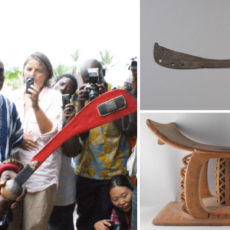
This distinction is important when discussing Akan history and identity. Akan civilisation developed through institutions that eventually established systems of political, spiritual, social, and cultural authority. Two complementary pillars define this tradition: male authority, represented by the oath and the sword, and female authority, represented by the oath and the authority of the stool. These institutions belong to the development of Akan society and its cultural order.
This article concentrates on what comes before those institutions: the origin of Nyame, the divine family from which Nyame is understood to have emerged, and the role Nyame plays as a connection between the spiritual and physical worlds.
C1 — The Beginning in the Spiritual World
According to the origin tradition presented here, the Akan family tree begins in the spiritual realm rather than on Earth. At the beginning of the genealogy stand two spiritual beings: Onyankopɔn and Odomankoma, also expressed as Oboamankoma. They represent the masculine and feminine principles of the divine family. Onyankopɔn occupies the paternal position, while Odomankoma/Oboamankoma occupies the maternal position. Their relationship produces Nyame, who is conceived in the spiritual realm but subsequently enters the physical world.
This makes Nyame the central figure connecting the two realms.
The genealogy can therefore be understood as beginning with:
Onyankopɔn — Father
Odomankoma/Oboamankoma — Mother
Nyame—Son
This is the foundation of what some Akan interpretations describe as a divine Trinity.
C2 — Onyankopɔn, the Father
Onyankopɔn represents the paternal and masculine characteristic within this interpretation of the Akan divine family.
The name has been interpreted in different ways within Akan linguistic and theological traditions. In the interpretation used in this account, the name is examined through component expressions, including Nya, Me, Ko, and Pon.
Nya can be understood as “get” or “obtain“, Me as “me“, Ko as “one“, and Pon as “great“.
This produces the interpretive expression:
“Get me one who is great.”
Within this origin story, Onyankopɔn therefore represents the great masculine spiritual principle associated with the beginning of life and the physical world. This interpretation should be understood as a theological and cultural reading of the name rather than as an uncontested modern linguistic etymology. Akan divine names have been interpreted differently across communities and by different scholars.
What is central to this particular tradition is Onyankopɔn’s position as Father in the divine genealogy of Nyame.
C3 — Odomankoma and Oboamankoma, the Mother
Opposite Onyankopɔn stands Odomankoma, also expressed as Oboamankoma. In this tradition, the two names are understood as dialectal forms referring to the same feminine, life-giving principle.
The name Odomankoma is interpreted through three concepts:
Ɔdum/Odom—the one who sustains, protects, helps, or gives support.
Ɔma/Ma—the one who gives.
Akoma—the heart, representing life, vitality, emotion, consciousness, and the centre of creation.
Together, these concepts are interpreted as:
“The Giver who gives the Heart.”
Or, more broadly:
“The life-giving and sustaining mother through whom the heart and life are conceived.”
The alternative form Oboamankoma can be interpreted through:
Oboa + Ma + Akoma
Where ‘Oboa’ means the one who helps or supports, ‘Ma’ means the one who gives, and ‘Akoma’ means the heart and life force.
Thus, within this tradition, Odomankoma and Oboamankoma are not two different mothers. They are interchangeable expressions whose forms reflect differences in Akan speech and dialect.
The underlying concept remains the same: the feminine, giving, nurturing, conceiving, and life-producing principle.
C4 — The Nine-Month Mystery of Conception
The maternal interpretation of Odomankoma becomes especially significant when the name is connected symbolically with the Akan understanding of conception and birth. Human life begins through conception. The developing child remains within the mother for approximately nine months before being delivered into the physical world. This process of conception, nurturing, development, and birth is associated in this interpretation with the feminine principle. Odomankoma therefore represents not merely a female deity but the process through which spiritual possibility becomes physical life.
The concepts contained within the name can consequently be understood symbolically as:
Giving → Conceiving → Carrying → Nurturing → Birth → Life
The word Akoma, “heart”, becomes particularly significant because the heart represents the living centre of a person. Through the heart, the unborn becomes the living; the spiritual possibility becomes physical existence.
Odomankoma is therefore understood as the female creative principle through which Nyame is conceived and brought forth.
C5 — The Conception of Nyame
From Onyankopɔn and Odomankoma/Oboamankoma comes Nyame.
Nyame is conceived in the spiritual realm.
However, according to this origin account, Nyame cannot remain permanently within the spiritual realm. He is sent into the physical world, the Earth, where he is able to embody characteristics originating from the spiritual realm while experiencing physical existence.
This makes Nyame unique.
He is neither simply a spiritual being nor simply an ordinary physical ancestor.
He becomes a bridge between the spiritual and physical worlds.
His genealogy begins in the spiritual realm, but his life unfolds within the physical realm.
C6 — Nyame, “The All”
The name Nyame is understood in this tradition as “The All“. This meaning is central to understanding Nyame’s position. Nyame represents the embodiment of the characteristics of the spiritual realm within the physical world. He carries the connection between the unseen and the seen, the spiritual and the physical. Through Nyame, the spiritual world becomes connected with earthly existence.
The relationship can therefore be expressed as:
Spiritual World → Nyame → Physical World
And after physical life:
Physical World → Death → Spiritual World
Nyame therefore occupies a central position within a continuous cycle connecting the living and the departed.
C7 — Nyame as the Bridge Between the Living and the Spirit World
A central feature of Akan spirituality is the relationship between the living, the ancestors, and the spiritual world. Within this origin story, Nyame provides a genealogical bridge between these realms. Onyankopɔn and Odomankoma exist before Nyame in the spiritual realm. Nyame enters the physical world. Human beings live within that world, eventually die, and return to the spiritual realm.
The movement can therefore be represented as:
Spirit → Birth → Physical Life → Death → Spirit
Nyame stands at the centre of this relationship.
This provides a framework for understanding why Akan people can sometimes use the name Nyame alongside other divine names, including the names of his spiritual parents. Because Nyame is understood as the bridge between the realms, his name can overlap conceptually with the broader spiritual identity represented by Onyankopɔn, Odomankoma, and other divine names.
C8 — Nyame and Yaa, the Earth Mother
After entering the physical world, Nyame is associated with Yaa, also known as Asaase Yaa. Asaase Yaa represents the Earth and the feminine earthly principle.
This creates an important distinction between two maternal figures within the origin narrative.
Odomankoma/Oboamankoma is the spiritual mother.
Asaase Yaa is the earthly mother.
Nyame, who originates in the spiritual world but enters the physical world, is therefore joined with the feminine principle of the Earth. Together, Nyame and Yaa establish the earthly ancestral line. Their union produces the next generation.
C9 — The First Children
Nyame and Yaa produce two children: a male child and a female child. These two children represent the next generation in the Akan ancestral genealogy. The male child continues the paternal line, while the female child continues the maternal line. Together they establish the ancestral foundation from which the Akan people are understood, within this tradition, to develop.
The genealogy therefore moves from the divine family into an earthly human family:
Onyankopɔn + Odomankoma
↓
Nyame + Yaa
↓
Male Child + Female Child
↓
Akan People
C10 — From the First Family to the Akan People
As generations pass, the descendants of the first family expand into communities, clans, settlements, kingdoms, and nations. These communities develop their own dialects, customs, political structures, spiritual practices, festivals, laws, and cultural identities. The Akan people therefore become a diverse family rather than a single uniform community.
The wider Akan cultural and linguistic world includes peoples such as the Bono, Asante, Akyem, Akuapem, Fante, Kwahu, Wassa, Agona, Nzema, and other related communities.
Their differences do not necessarily require separate creation stories. Within the genealogy presented here, they can instead be understood as different branches of a larger ancestral family.
C11 — The Place of Bono within the Akan Family
The Bono occupies an important position within the wider Akan story. Bono identity should not simply be reduced to another name for all Akan people. The Bono developed their own political institutions, cultural practices, traditions, language forms, history, and identity.
At the same time, Bono history forms part of the wider Akan cultural and ancestral world.
This distinction is important for Bono Kyempem: the objective is to preserve Bono identity while recognising its relationship with the wider Akan family. The ancestral genealogy provides the broad family connection. Bono culture provides one of the distinctive branches of that family.
C12 — The Origin of Akan Culture Is a Separate Story
The origin of the Akan people should not be confused with the origin of Akan culture. The genealogy explains the ancestral origin of the people. Culture developed later through the experiences and achievements of generations of Akan people.
Akan culture encompasses political authority, customary law, clan organisation, inheritance, spirituality, language, ceremonies, festivals, music, art, architecture, agriculture, trade, warfare, education, social responsibilities, and systems of leadership. The culture therefore represents the development of a civilisation rather than simply the biological continuation of a family.
C13 — The Two Pillars of Akan Authority
Within the cultural framework described in this tradition, two complementary pillars are particularly important: male authority represented through the oath and sword, and female authority represented through the oath and authority of the stool. The sword represents the male authority associated with leadership, protection, responsibility, the oath, and the defence of the community.
The stool represents the female or maternal authority associated with ancestry, legitimacy, continuity, lineage, land, and the spiritual identity of the community. These two authorities should not simply be understood as competing systems.
They represent complementary forces:
Sword and Stool
Male and Female
Protection and Continuity
Authority and Ancestry
These institutions belong to the development of Akan civilisation and should therefore be distinguished from the earlier divine genealogy of Nyame.
C14 — Nyame and the Akan Connection to the Spiritual World
The importance of Nyame is therefore not simply that he is identified as a divine son. His importance lies in his position between worlds.
Nyame is the child of:
Onyankopɔn — Father
and
Odomankoma/Oboamankoma — Mother.
He is conceived spiritually and enters the physical world.
He becomes the embodiment of the spiritual within the physical. Through his earthly relationship with Yaa/Asaase Yaa, the divine family becomes connected to the ancestral family. The story therefore provides a conceptual explanation for why Akan identity can be understood as simultaneously connected to God, Earth, ancestors, family, and community.
C15 — The Names of God and Their Relationship
Because Nyame is positioned as the bridge between the spiritual and physical realms, Akan spiritual language can contain overlapping divine names. Nyame may be invoked alongside Onyankopɔn, Odomankoma, Oboamankoma, or expressions such as Odomankoma Onyankopɔn.
Different Akan communities may explain these names differently, and there is no requirement that every dialect or tradition interpret them identically. The important point within this particular tradition is that the names exist within an interconnected spiritual vocabulary. They express different relationships and characteristics of the Divine rather than necessarily representing unrelated beings.
C16 — The Complete Akan Divine Family Tree
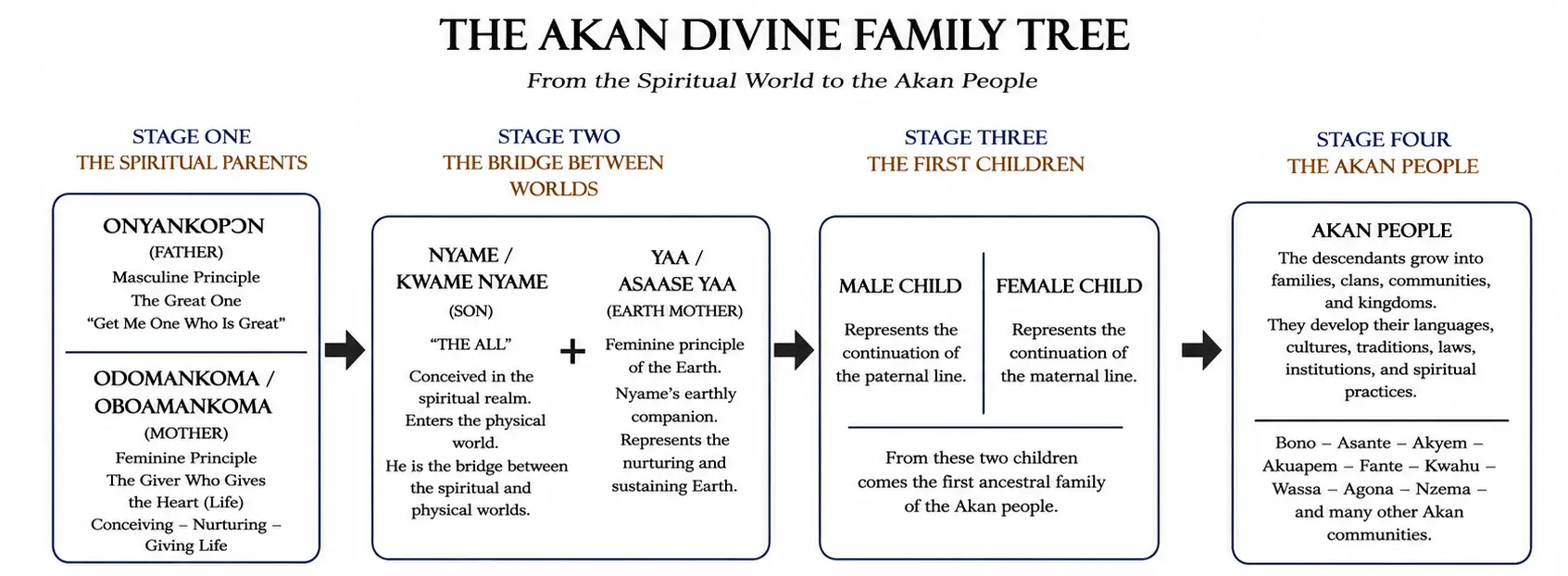
The genealogy can therefore be represented in four stages:
Stage One — The Spiritual Parents
Onyankopɔn
Father / masculine spiritual principle
Odomankoma / Oboamankoma
Mother / feminine, giving and conceiving spiritual principle
↓
Stage Two — The Bridge Between Worlds
Nyame / Kwame Nyame
The spiritually conceived son, identified as “The All”, who enters the physical world
Yaa / Asaase Yaa
Earth Mother and Nyame’s earthly companion
↓
Stage Three — The First Children
Male Child
Female Child
↓
Stage Four — The Akan People
The descendants develop into different Akan communities, clans, kingdoms, and dialect groups, including the Bono and other branches of the wider Akan family.
C17—From the Divine Family to Akan Civilisation
The story does not end with the birth of the first children.
The descendants expand.
Families become clans.
Clans become communities.
Communities develop political institutions.
Political institutions develop kingdoms.
Kingdoms preserve laws, customs, spiritual traditions, languages, symbols, and systems of authority.
Through generations, the Akan people develop the civilisation that exists in diverse forms today.
The movement can therefore be understood as:
Spiritual Parents
↓
Nyame
↓
Nyame and Yaa
↓
First Children
↓
Ancestral Families
↓
Clans and Communities
↓
Kingdoms and Institutions
↓
Akan Civilisation
↓
Akan People Today
C18 — The Meaning of the Genealogy for Akan Identity
The deeper significance of this origin story is not simply the identification of ancient ancestors. It provides a framework for understanding belonging. If Nyame originates in the spiritual realm and enters the physical world, and if the Akan people descend from Nyame’s earthly family, then Akan identity is connected simultaneously to:
Spirit
Earth
Family
Ancestors
Community
Culture
and Creation.
The story therefore provides a spiritual framework through which the Akan people can understand themselves without separating their cultural identity from their relationship with the Divine.
The ancestral story begins with the spiritual world and eventually arrives at the living people of today.
Conclusion — From Nyame to the Akan People Today
The origin story begins before the establishment of kingdoms, stools, swords, villages, clans, or dialects. It begins in the spiritual world with Onyankopɔn and Odomankoma/Oboamankoma. Onyankopɔn represents the paternal and masculine principle, while Odomankoma/Oboamankoma represents the maternal and feminine principle of giving, conception, nurturing, and life.
From their spiritual relationship comes Nyame — “The All”.
Nyame enters the physical world and becomes the bridge between the spiritual and physical realms. He joins with Yaa/Asaase Yaa, the earthly feminine principle, and together they produce a male and female child. From these children comes the expanding ancestral family that develops into the diverse Akan communities of today.
The origin of the Akan people, therefore, is one story.
The development of Akan culture, spirituality, authority, traditions, and civilisation is another. The two stories meet through ancestry. The genealogy explains the connection between the Akan people and the spiritual world. The cultural tradition explains how the descendants of that ancestral family built their societies, preserved their institutions, developed their languages, and created the civilisation that continues through the Akan people today.
For the Bono and the wider Akan family, this genealogy can therefore serve as a starting point for a broader exploration of ancestry, spirituality, culture, authority, tradition, and the continuing relationship between the living, the ancestors, the Earth, and the spiritual world.