

Humanity’s jump from fewer than 1 billion people to more than 8 billion in a little over 200 years is one of the clearest megatrends of modern history. It reshaped economies, cities, nature, and daily life. But how did it happen, what good and bad did it bring, and are we still in a boom — or moving toward a different era entirely?
Why the boom happened (short, common-sense summary)
A handful of long-running, interacting changes drove the population boom:
- More reliable food and farming technology (mechanised agriculture, fertilizers, global trade) reduced famine and raised carrying capacity.
- Industrialisation and rising incomes improved living standards, nutrition and transport.
- Public health and medical advances (vaccines, antibiotics, sanitation) sharply cut infant and child mortality and raised life expectancy.
- Globalisation and technology allowed food, medicines and know-how to spread worldwide faster than ever.
Put together, fewer people died and more people survived to adulthood — meaning population accelerated even as fertility rates eventually began to fall. These broad trends are documented in the United Nations’ long-term population estimates and projections.
The hard numbers (quick snapshot)
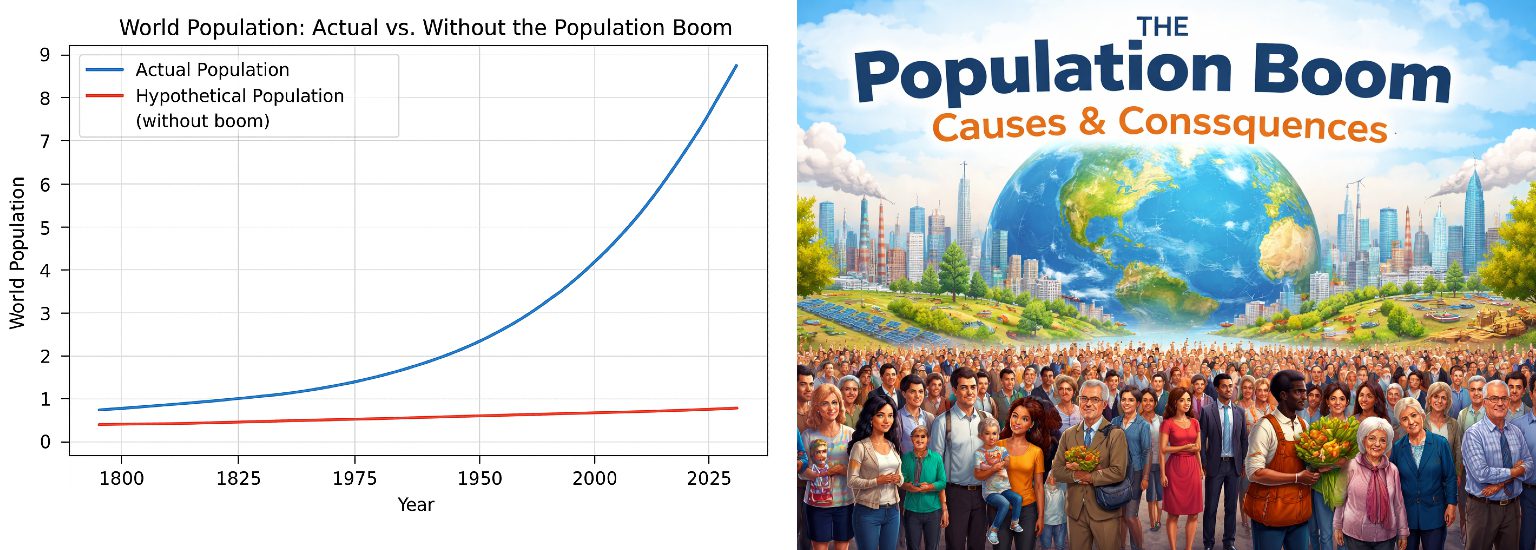
According to UN population data, the world grew slowly for millennia, then climbed steeply after 1800 and especially during the 20th century to reach roughly 8 billion in the 2020s. Projections now show slower growth ahead, but a huge shift has already occurred.
Advantages of the boom
- Economic scale and specialization. More people mean larger domestic markets, more specialised labour, and faster innovation — think mass manufacturing, large urban services, and diverse professions. Entrepreneurs generate growth and jobs.
- Scientific and medical progress. The larger human population accelerated knowledge creation and funding for health research that in turn supported more growth.
- Rising standards of living (for many). Industrialisation and higher productivity lifted billions out of extreme poverty over the last century. The UN/Our World in Data materials show clear poverty-reduction trends concurrent with population growth.
- Demographic dividends. In many countries, a relatively large working-age population supported fast GDP growth for decades.
Disadvantages and harms
- Environmental pressure. More people consume more land, water, and materials — accelerating biodiversity loss, deforestation, freshwater stress, and greenhouse gas emissions. WWF and environmental research have repeatedly linked rising consumption and population to ecosystem strain.
- Resource constraints and inequality. Growth hasn’t been distributed evenly: many countries or regions still lack reliable access to food, clean water, or health care,e even while global totals rise.
- Urban stress and infrastructure gaps. Rapid urbanisation creates slums, congestion, and infrastructure backlogs when growth outpaces planning.
- labor Short-term economic dislocations. Fast growth can destabilise local labour markets, and sudden shocks (pandemics, financial crises, and energy price spikes) can produce layoffs and business failures that hit the vulnerable hardest.
Planet, resources and development — the tradeoffs
- Planet: A larger population expands the human “footprint.” Even if per-capita emissions and consumption fall in some countries, total resource use and biodiversity loss remain big concerns. WWF and other environmental authorities warn that current consumption patterns plus population growth put pressure beyond planetary boundaries.
- Resources: Agricultural yields and technology have so far kept food production ahead of population for most regions, but water, soils and some minerals are locally stressed. Smarter use, reduced waste and technology can ease strain — but they require investment and global cooperation.
- Development: Population growth has both helped (bigger markets, more talent pools) and hindered (infrastructure shortfalls, governance strain) development. The net outcome depends heavily on institutions, policy choices and whether societies invest in education, health and productive jobs.
The economy today: layoffs, insolvencies, and structural change
Population dynamics interact with short-term economic cycles and structural shifts:
- Layoffs and local shocks. Academic studies show that mass layoffs can produce long-term scarring on local employment and incomes, requiring absorptive capacity and retraining to recover.
- Business insolvencies & administrations. In some economies, rising costs, energy shocks or weak demand translate into a higher rate of bankruptcies (recent reporting highlights industry-specific and country cases). For instance, reports forecast elevated corporate insolvencies in parts of Europe as firms face a challenging macro environment.
- Demographics & demand composition. An ageing population changes demand (more healthcare, fewer school enrollments), which can reduce opportunities in some sectors and create “silver economy” opportunities in others — the IMF highlights potential benefits from healthier, active older populations if policy and technology adapt.
So: population size is one factor in layoffs and insolvency, but the proximate causes of business distress are usually macroeconomic shocks, industry disruption, regulatory environments and cost structures. Demography shapes long-term demand and labour supply, not day-to-day bankruptcies.
Was the boom temporary?
This is the central debate among demographers and public intellectuals.
- Alarmists of the past: Paul Ehrlich and others warned in the 1960s–70s that unchecked growth would cause mass famine and collapse. Many of their worst-case predictions did not occur because technology and institutions mitigated the risks — but their warnings highlighted real vulnerabilities.
- Contemporary alarm on the opposite front: In recent years, thinkers such as Jonathan Last and Nicholas Eberstadt (among others) have warned about declining fertility and an impending era of slow growth or even depopulation in many countries — with big fiscal, labour and innovation implications. Governments in parts of Europe, East Asia and elsewhere are already experimenting with pro-natalist policies because of falling birth rates.
- A middle, evidence-based view: The UN and leading demographers now project that global population growth will slow and likely plateau during the 21st century, with regional variation: some countries will age and shrink, others (mostly in sub-Saharan Africa) will continue to grow and shape global demographics. This means the “boom” was not a one-off spike but a multi-century phenomenon that is now transitioning to a new phase of slower growth and population ageing.
Bottom line for readers (common-sense takeaway)
- The population boom was driven by better food, medicine and technology. It brought enormous economic and human gains — but also serious environmental and social stresses.
- Today’s challenge is not simply “more people = bad” or “fewer people = bad.” It’s how societies adapt: investing in clean energy, efficient food systems, education, lifelong learning and policies that help people work productively longer or raise fertility only if that’s a desired outcome. The debate has shifted from fear of overpopulation to managing uneven demographic transitions globally.
Sources and further reading (select)
- United Nations — World Population Prospects (latest revisions and country-level projections).
- Our World in Data — synthesis and commentary on population trajectories.
- Paul R. Ehrlich — The Population Bomb (historical landmark on overpopulation debates).
- Jonathan Last — What to Expect When No One’s Expecting (arguments about fertility decline).
- Nicholas Eberstadt — essays on depopulation and socioeconomic effects.
- WWF — Living Planet / biodiversity reports on consumption and ecological pressures.
- IMF and recent reporting on the “silver economy” and ageing societies.
- Academic work on mass layoffs and local economic effects.
- Recent reporting on insolvencies and business stress (example: Reuters reporting on German corporate insolvencies).