
How Technology Could Be Part of a Better Solution — “Green Revolution” Has Left Many Farmers Behind
The Promise vs. the Reality
Over decades, governments, multinational donors and private agribusinesses have promoted what is often called a Green Revolution — the idea that modern agricultural inputs (improved seeds, chemical fertilisers, mechanisation and other technologies) can dramatically increase food production and end hunger. In theory, these technologies are meant to boost yields, reduce food insecurity and lift smallholder farmers out of poverty. In practice, many farmers in Ghana’s Brong Ahafo region — a zone known as the country’s “food basket” — report very different experiences. The second wave of the Green Revolution, active since the early 2000s and supported by initiatives like AGRA and USAID alongside public policy, has not lived up to its promise for most smallholder producers.
Uneven Impacts in the Brong Ahafo Region
The Brong Ahafo area — now administratively split into Bono, Bono East and Ahafo — produces staples like maize, yams, plantains, rice and groundnuts. Its fertile soils and favourable climate make it ideal for crop cultivation. Yet the outcomes of modern agriculture here are mixed at best.
Key local challenges include:
Rising costs: Commercial inputs often cost more than the benefits farmers receive — especially without guaranteed markets or price supports.
Debt burden: Farmers using modern seed and fertiliser are increasingly indebted to buy these inputs, eroding net incomes.
Inequality: Larger, capital-rich farmers can secure contracts and markets, while smallholders struggle to benefit.
Food system risks: Many small producers are shifting from food crops to export-oriented cash crops, thereby weakening local food security.
Taken together, these factors show that simply applying “Green Revolution” technology hasn’t ensured prosperity for local farmers — especially the poorest and landless.

Where Technology Can Truly Help
While the traditional model of high-input agriculture hasn’t delivered equitable gains, appropriate technology — especially digital and mechanised tools — holds strong potential to improve outcomes when paired with supportive systems.
1. Agritech and Digital Tools
Mobile platforms and ICT (Information and Communication Tech) can help close information and market gaps in rural Ghana. Tools include:
Weather forecasts and crop alerts that help farmers plan planting and pest control.
Price and demand information apps connecting producers directly with buyers, reducing reliance on middlemen.
Mobile money services that allow farmers to receive payments, save securely and access microcredit without traditional banks.
Studies show that ICT significantly boosts productivity, but wider adoption requires investment in digital literacy and rural communication networks.
2. Mechanisation Matched to Scale
Mechanised tools — from improved hand tools to service-center tractor access — can reduce labour, save time and improve soil management. Research in the Brong Ahafo transitional zone points to the value of conservation agriculture paired with tailored mechanisation. These methods:
Improve soil moisture retention and decrease the need for long fallow periods.
Cut down drudgery and labour costs.
Increase farm efficiency without over-dependence on external inputs.
However, for mechanisation to work at small scale, systems like tractor service centres and farmer cooperatives that share equipment and expertise are essential.
3. Precision Agriculture and Emerging Tech
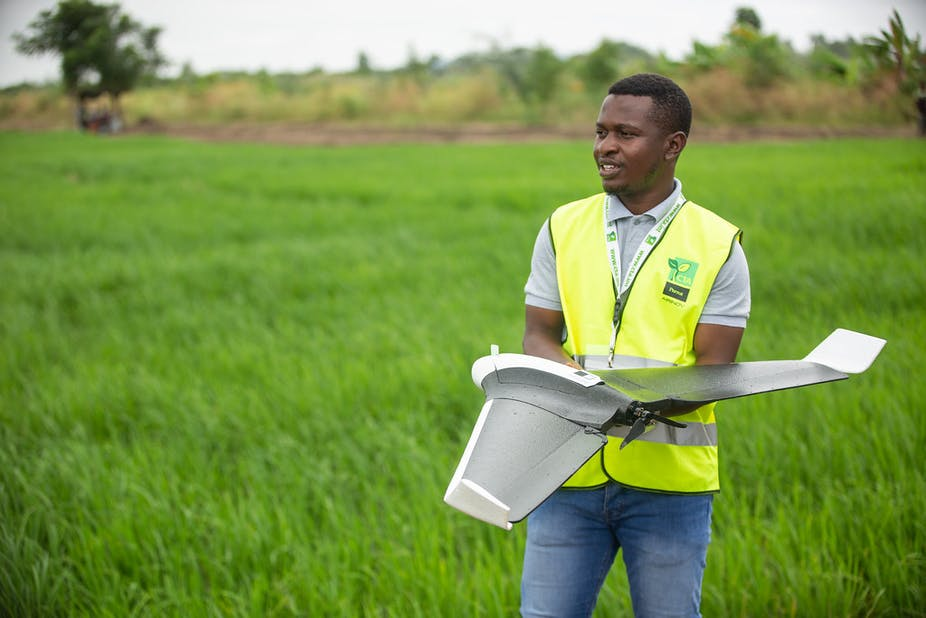
Emerging tools such as drones, sensors, IoT devices and data analytics — even if currently more common in wealthier countries — offer visions of a more efficient future. These technologies can:
Provide real-time crop health data allowing targeted irrigation and fertiliser use.
Improve water management through smart irrigation systems tied to soil and weather data.
Lower waste by applying inputs only where needed, reducing costs and environmental impact.
While still emerging in Ghana, such innovations could increase yields and sustainability — particularly if adapted to smallholder needs rather than one-size-fits-all solutions.
Technology Should Empower Farmers First
The major lesson from the Green Revolution experience in Ghana is that technology alone cannot solve structural problems like market access, land tenure inequities and financial exclusion.
Instead, a farmer-centric approach that:
Prioritises local knowledge,
Builds on appropriate technology,
Strengthens digital and organisational capacity, and
Ensures fair market structures and supportive policies
is far more likely to deliver equitable growth and food security.
With the right technological ecosystem — one that improves information flow, reduces risk, and enhances productivity without making farmers dependent on expensive inputs — Ghana’s agricultural sector can become both more productive and more just.























Recent Comments